
@conrad-vandermark


Was Jack the Ripper a Woman?
January 16, 2023 in Unsolved Crime

Jack the Ripper. The mere mention of the name provokes an instinctual sense of dread enough to make the hair on the back of your neck stand on end. The fact that he was never caught irrationally weighs heavily on the human psyche, almost giving one the feeling that he may still be out there lurking in the shadows 130+ years later. While we can be sure this is not the case, one thing that we cannot be sure of is who he was, or should I say, who she was. That’s right. A new theory suggests that Jack may not have been a Jack at all. Jill the Ripper? While it doesn’t have the same ring to it, it has become a very plausible theory, and for good reason.
During the span of the murders, various press outlets and Scotland Yard received several letters supposedly from the killer himself. The most notable of these letters, dubbed the Hell letter (as it was signed “from Hell” and contained a piece of human kidney), was sent to one George Lusk, the head of the Whitechapel Vigilance Committee, a group of volunteers who patrolled the Whitechapel streets. It was this gruesomely taunting letter that gave rise to the name Jack the Ripper, sending a wave of hysteria across England and the rest of the world.

In the early 2000s, Ian Findlay, a professor of molecular and forensic diagnostics, used swabs he took from the “Openshaw letter”, which is the one believed to be the most likely genuine, and utilizing a technique he himself had created, was able to build a partial DNA profile of the would-be killer. Surprisingly, the results suggest that the world’s most famous killer may have been a woman.
Up to the time of the fifth and debatably final Ripper victim, Mary Jane Kelly, the police of Scotland Yard had four suspects, all male. However, a witness stated she had “seen” Kelly hours after she had been murdered, resulting in the chief inspector’s theory that what the witness had actually observed was the killer escaping in Kelly’s clothing. The most likely suspect, according to this theory, is Mary Pearcey. In 1890, Pearcey was convicted of murdering her lover’s wife and child, having used a similar modus operandi to that of the Ripper in committing the crimes.

Sources:
“Mary Pearcey”, Wikipedia
“Was Jack the Ripper A Woman?”, history.com
“Jack the Ripper”, Wikipedia

Would Time Travel Create an Inescapable Paradox?
January 5, 2023 in Science & Technology
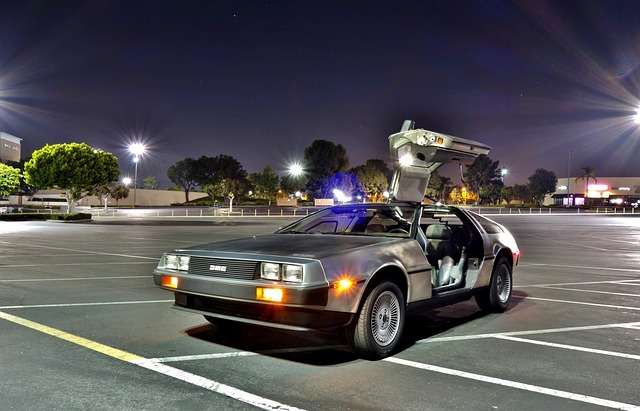
We’ve all thought about it at one time or another. What if you could go back in time and change your life for the better? Just hop in your DeLorean, fire up the flux capacitor, smack the gas to 88 MPH, and you’re aces! Right? Well maybe…
While time travel is believed to be possible within the laws of physics as we currently understand them, there is a catch. According to some researchers, time travelers could not succeed in altering their version of the past in any measurable way due to the probability that doing so would create a paradoxical scenario, i.e.; The Grandfather Paradox.
The grandfather paradox or consistency paradox is a hypothetical problem that is believed to arise if one were to go back in time and assassinate one’s grandfather before he ever met one’s grandmother. This action would stop the two from ever conceiving either your mother or father, and ultimately result in you never having been born to assassinate your grandfather in the first place.
However, recently University of Queensland undergraduate student Germain Tobar, who has been investigating the possibility of paradox-free time travel under the supervision of physicist Dr. Fabio Costa, affirms their research shows that it is theoretically possible for future events to adjust themselves, keeping consistent with the would-be actions of a time traveler.
“Events readjust around anything that could cause a paradox, so the paradox does not happen.”
“Try as you might to create a paradox, the events will always adjust themselves to avoid any inconsistency.
“The range of mathematical processes we discovered shows that time travel with free will is logically possible in our universe without any paradox.”
Tobar’s work can be found published in Classical and Quantum Gravity
Source: The University of Queensland
Can you spot the Loch Ness Monster?
December 31, 2022 in Cryptozoology

Have you ever wanted to catch your own glimpse of Scotland’s most famous cryptid, but a trip to the Scottish Highlands just isn’t in your vacation plans anytime soon? Well, good news! You don’t even have to leave the couch to add it to the itinerary.
Recently, Visit Inverness Loch Ness (VILN) has added several webcams to lodgings around the loch with the intention of luring would-be travelers to the area by providing a bird’s-eye view of local landscapes and wildlife. But of course, avid Nessie hunters are keeping a keen eye on webcams as well, in the hopes of catching a glimpse of the loch’s most famous resident.
Here’s a list of webcam locations:
Craigdarroch Hotel, Foyers
Drovers Lodge, Drumnadrochit
Shoreland Lodges, Fort Augustus
Loch Ness Clansman Hotel
Airanloch B&B, Lochend
Pinewood Steading
And of course, the webcams
Safe Travels & Happy Hunting!
The Haunted Legacy of the Lalaurie Mansion: New Orleans’ House of Horrors
May 26, 0202 in Hauntings, Louisiana
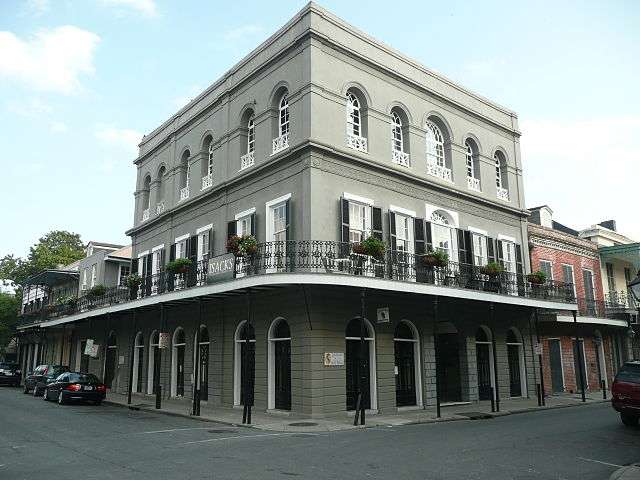
Image: Wikimedia Commons
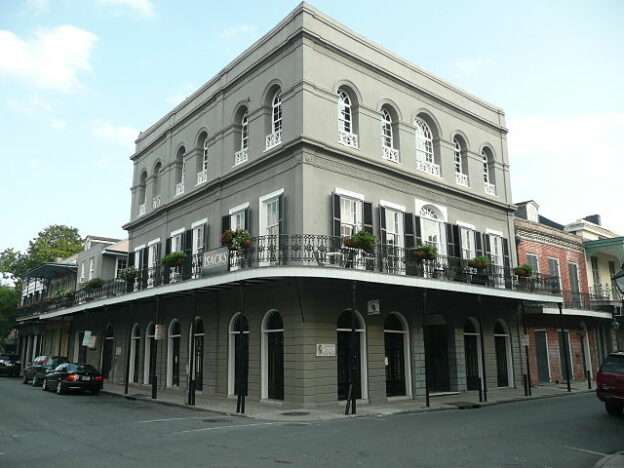
On Royal Street in New Orleans’ French Quarter, the Lalaurie Mansion rises like a dark jewel among the pastel façades, its wrought iron balconies curling like blackened lace and its carved doors hinting at secrets long buried. By day, it might be admired as a relic of refined 19th-century elegance. From the cupola atop its third floor, one could once gaze over the Vieux Carré and watch the Mississippi River curve gracefully before Jackson Square—a panorama of beauty that could lull the unwary into believing the mansion held nothing but charm. But appearances here are treacherous. Behind every polished surface, every gilded railing, lies a history drenched in blood and whispered horror.
Marie Delphine Macarty, the woman who would become Madame Lalaurie, moved through New Orleans society with the confidence of someone born to power. Three marriages and a family name steeped in influence cemented her place among the European Creole elite. Her household, like many of the era, relied on enslaved labor—but Madame Lalaurie’s cruelty transcended the accepted norms. Rumors circulated, hushed at social gatherings, dismissed as exaggeration… until the day the mansion revealed its true face.
That day came on April 10, 1834, when a fire broke out in the kitchen. Firefighters and neighbors arrived, expecting a typical blaze—but what they discovered would etch itself into the city’s darkest memory. Chained to the stove was the elderly cook, her trembling confession chilling every ear: she had tried to set the fire herself, desperate to escape punishment. Those “in need of punishment,” she whispered, were taken to the upper floors, never to return.
Curiosity and terror compelled the crowd to act. Denied the key to the forbidden rooms, they forced entry—and encountered the unimaginable. There, in the upper chambers, lay seven enslaved people, mutilated in every conceivable way, evidence of horrors so grotesque they defy description. The mansion, once a symbol of refinement, revealed itself as a crucible of suffering, and the woman who presided over it showed no remorse. When questioned, her husband’s callous words cut sharper than any blade: “Some people had better stay at home rather than come to others’ houses to dictate laws and meddle with other people’s business.”
The city erupted in outrage. A mob descended upon the mansion, smashing windows, tearing furniture apart, and leaving chaos in their wake. And yet, amid the destruction, Madame Lalaurie vanished. Some say she slipped away to the waterfront, boarding a schooner bound for Mobile, Alabama, before fading into the shadows of Paris. Others whisper that she never truly escaped, that her presence lingers, unseen but felt, in the echoing halls of her former home.
Even now, the mansion seems alive with memory. Locals claim to hear the faint cries of those who suffered there, carried on the humid breeze that drifts through the Quarter. Some swear they see figures moving behind the blackened iron gates, shadows that vanish when approached.
- « Previous
- 1
- 2