Coral Castle
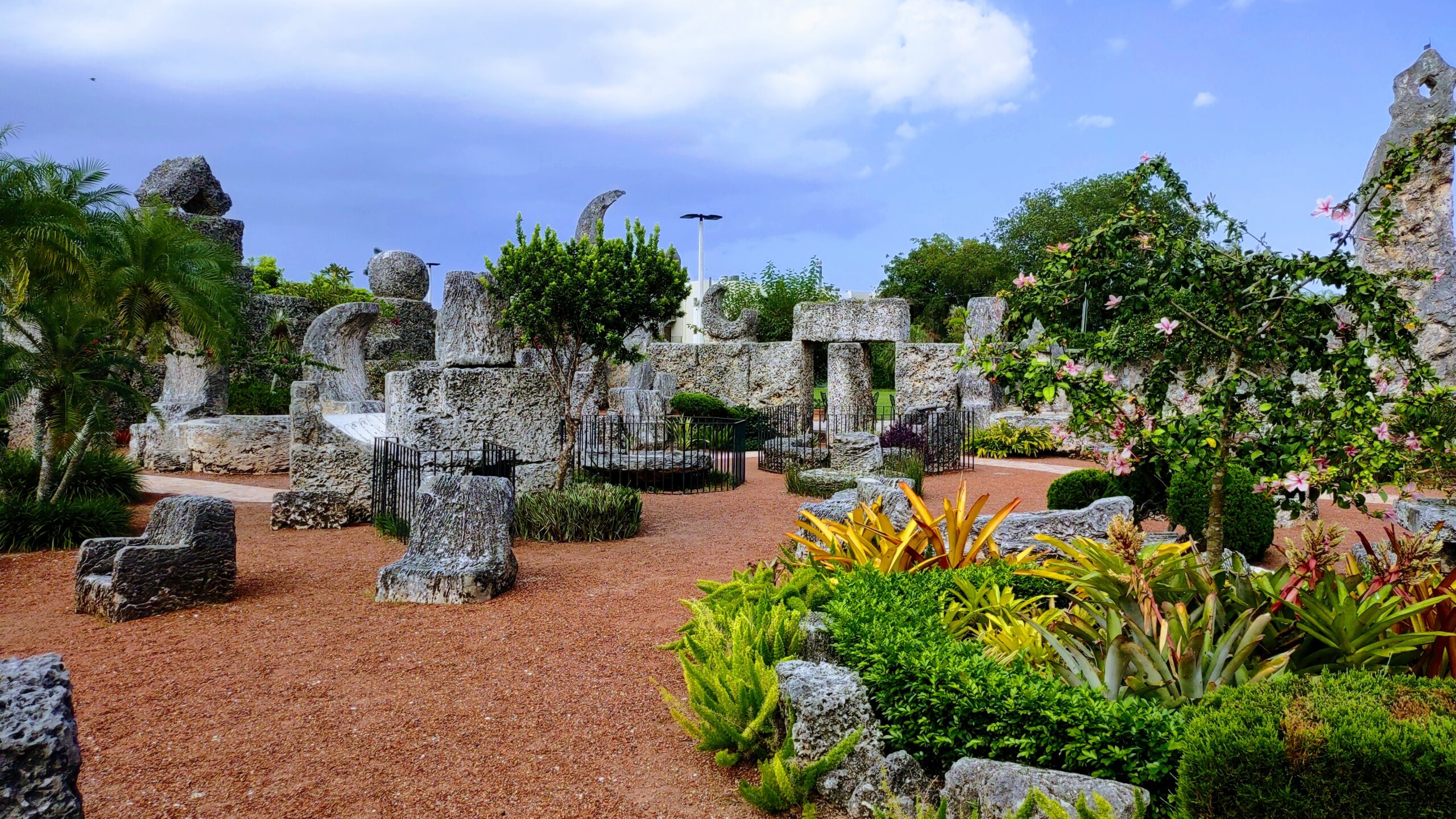
Coral Castle. Built between 1923 and 1951 by Edward Leedskalnin, a Latvian immigrant who stood approximately five feet tall and weighed around 100 pounds, the structure contains massive blocks of oolitic limestone carved into walls, towers, chairs, tables, and other remarkable creations. What makes Coral Castle so fascinating is not just its appearance, but the fact that one man managed to build it by himself.
Leedskalnin claimed to understand the laws of weight and leverage, but he rarely explained his construction methods. He reportedly worked mostly at night, guarded his work from curious onlookers, and left behind few detailed explanations of how he cut, lifted, and transported the enormous stones.
Although modern engineering can explain many of the principles that may have made the project possible, some details of Leedskalnin’s exact methods remain uncertain, like how he organized and carried out such an extraordinary project with limited resources and so little assistance.
Who Was Edward Leedskalnin?
Edward Leedskalnin was born in Latvia in 1887. As a young man, he became engaged to a woman named Agnes Scuffs, who was reportedly ten years younger than him. According to the story associated with Coral Castle, Agnes ended their engagement shortly before their planned wedding. Leedskalnin later immigrated to North America and eventually settled in Florida.
His broken engagement became an important part of the story surrounding Coral Castle. He dedicated the structure to the memory of his lost love, and many people have interpreted the enormous amount of work he put into it as an expression of heartbreak, devotion, and determination.
Whatever his personal motivations, they cannot be established entirely from the stones themselves. What is clear is that he devoted decades of his life to creating the structure.
Leedskalnin was also interested in magnetism, electricity, and physical forces. He published small booklets discussing his ideas about magnetism and the nature of matter.
Rather than openly demonstrating his techniques, however, Leedskalnin kept much of his work private. This secrecy became one of the main reasons Coral Castle developed its reputation.
The Construction of Coral Castle
Construction began around 1923 in Florida City, where Leedskalnin initially built his stone complex. In 1936, he relocated the structure to its present location in Homestead after learning that development was planned near his original property. He reportedly dismantled the structure and transported its stones to the new site, where he spent years rebuilding and expanding it.
The project eventually became known as Coral Castle, although the material used is primarily oolitic limestone rather than coral itself. This type of limestone consists of small, rounded mineral grains and can be worked with suitable tools.
The site contains an estimated 1,100 tons of stone, arranged into walls, towers, furniture, astronomical features, and other structures. Some individual blocks weigh many tons, and certain estimates place the largest pieces in the range of 20 to 30 tons or more.
Among the site’s most recognizable features are a massive stone entrance gate, a heart-shaped table, a Polaris telescope, a sundial, and a two-story tower that served as Leedskalnin’s living and working quarters. The pieces were not simply piled together. Many were cut and positioned with considerable care, creating a complex that combined practical construction with artistic design.
Because he rarely allowed people to observe him working, much of what happened during those years remains open to interpretation.
How Did He Move the Stones?
The central question surrounding Coral Castle is how a man of such small stature could move and position blocks weighing several tons without a modern construction crew.
At first glance, the task seems almost impossible. Moving a massive stone requires overcoming friction, controlling its balance, and preventing it from tipping or crushing anything beneath it. Lifting a block also requires equipment capable of supporting its weight safely. Yet Leedskalnin completed the project without the large cranes and heavy machinery commonly used on construction sites today.
Why Did He Work in Secret?
Another major part of the mystery is Leedskalnin’s insistence on privacy. Reports describe him working primarily at night and discouraging people from watching his construction methods. Curious visitors sometimes asked how he moved the stones, but he did not provide a detailed technical explanation.
His secrecy created an unusual situation: a remarkable construction project took place over decades, yet there was no continuous public record of how it was built.
There are several possible explanations for this behavior. Leedskalnin may simply have valued his privacy and independence. He might have enjoyed allowing people to wonder about his work, or he may have wanted to protect techniques he had developed through trial and error. Working at night could also have provided cooler conditions in Florida’s hot climate, although this does not establish why he chose those hours.
Without a detailed explanation from Leedskalnin himself, it is impossible to know his full reasons.
The Famous Nine-Ton Gate
One of the most remarkable features of Coral Castle was its enormous stone entrance gate. The gate weighed approximately nine tons, yet it was designed to rotate so smoothly that visitors could reportedly open it with very little effort.
This feature became one of the strongest examples used to support claims that Leedskalnin possessed extraordinary engineering knowledge. The contrast between the gate’s enormous mass and its apparent ease of movement seemed almost unbelievable.
In 1986, the gate stopped functioning properly. When workers attempted to repair it, they discovered that its movement depended on an engineered pivot system involving a metal shaft and a truck bearing. The gate was removed and later reinstalled, but it failed again in 2005. A more extensive restoration followed.
The engineering achievement should not be dismissed simply because a mechanical explanation exists. Positioning a heavy stone so that its center of mass aligns properly with a pivot requires precision. The gate demonstrates that Leedskalnin understood how careful alignment and mechanical design could make a massive object surprisingly easy to move.
The gate’s history also illustrates a distinction that appears throughout Coral Castle: explaining the physical principle behind a feature does not necessarily tell us every detail of how Leedskalnin constructed it.